
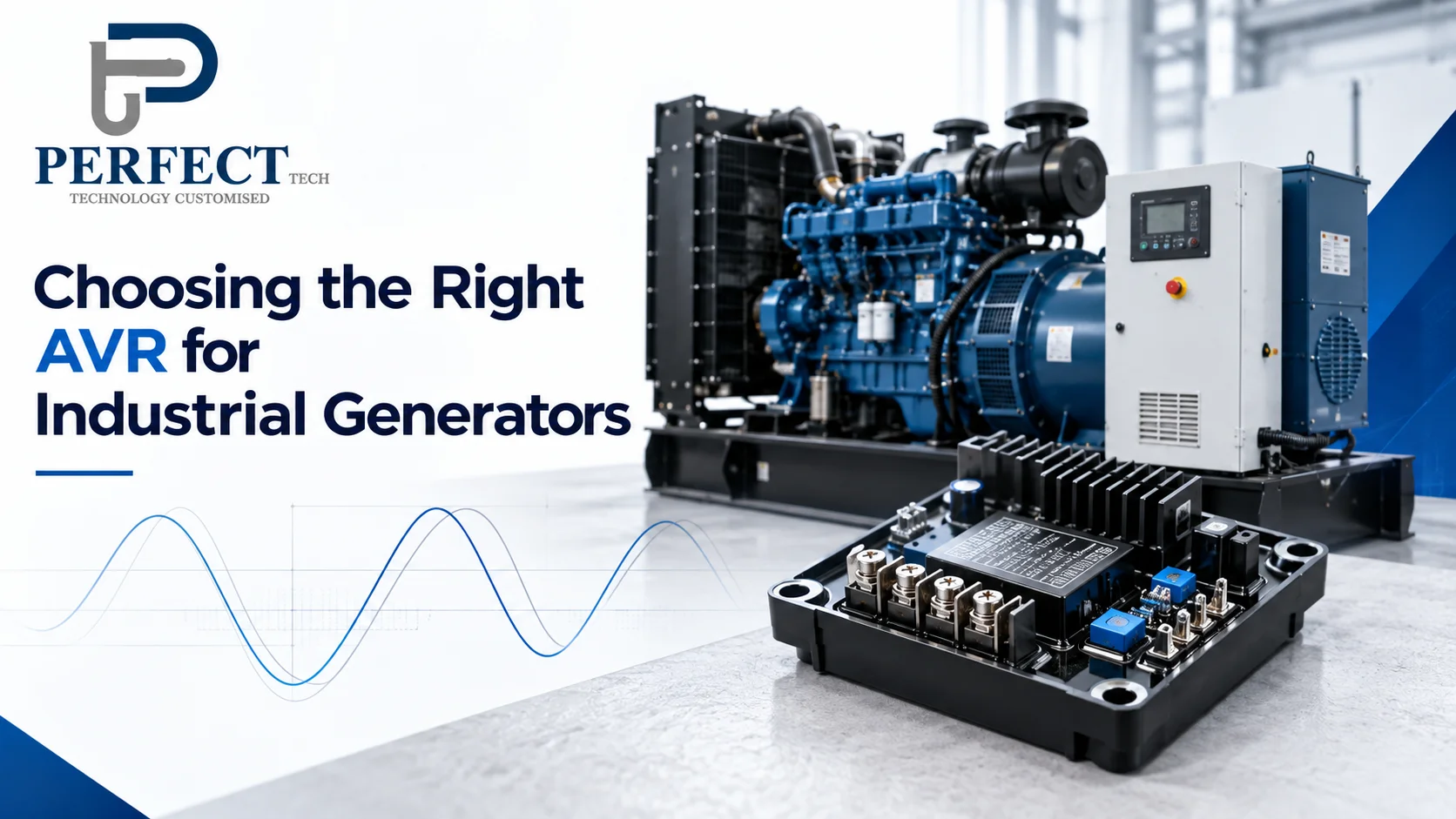
Industrial generators operate in environments where voltage stability, equipment reliability, and uptime are critical. An incorrect or poorly matched regulator can cause unstable voltage, sensitive equipment faults, generator overheating, and unexpected downtime. For procurement teams and maintenance engineers, selecting the right industrial generator AVR is therefore more than simply matching a part number—it requires understanding the generator’s electrical characteristics, excitation system, and operating conditions.
Whether you are maintaining backup power for an industrial plant, airport ground support operation, data facility, or heavy-duty commercial installation, choosing the correct AVR can significantly improve generator performance and reliability.
What Is an Automatic Voltage Regulator?
An Automatic Voltage Regulator (AVR) is an electronic control component that maintains a generator’s output voltage within a specified range.
The AVR continuously monitors generator voltage and adjusts the excitation current supplied to the alternator’s field winding. When the electrical load changes, the AVR responds to help maintain stable output voltage.
A typical generator AVR performs several important functions:
- Voltage sensing and regulation
- Excitation control
- Voltage stability during load changes
- Compensation for generator operating conditions
- Protection against certain abnormal voltage conditions
- Support for consistent alternator performance
For industrial applications, the AVR is a critical part of the generator’s excitation and voltage-control system.
Why Choosing the Correct Industrial Generator AVR Matters
Not every AVR is compatible with every generator. Installing a regulator based only on physical appearance can result in poor performance or complete system failure.
A correctly matched AVR can help provide:
- Stable generator output voltage
- Improved response to sudden load changes
- Reliable operation of connected machinery
- Reduced risk of electrical equipment damage
- Better generator availability
- Longer component service life
- Reduced maintenance-related downtime
For airports and industrial facilities, these benefits are particularly important because generator failure can affect critical infrastructure and operational continuity.
Key Factors When Selecting an Industrial Generator AVR
Before purchasing an AVR, maintenance and procurement teams should verify the technical requirements of the generator and alternator.
1. Generator and Alternator Manufacturer
Start by identifying the exact generator or alternator manufacturer.
Common information includes:
- Generator manufacturer
- Alternator manufacturer
- Generator model
- Alternator model
- Serial number
- Manufacturing year
- Excitation system type
The alternator model is particularly important because the AVR is generally associated with the alternator’s excitation system rather than simply the engine.
When possible, obtain the original AVR part number from the existing component.
2. Original AVR Part Number
The original part number is one of the most useful references for industrial spare parts procurement.
Check the AVR label for:
- Part number
- Model number
- Manufacturer
- Voltage rating
- Frequency
- Sensing voltage
- Excitation specifications
However, an identical-looking component should not automatically be considered a replacement. Always verify electrical specifications and compatibility.
3. Voltage Sensing Range
The AVR must be designed to sense the generator’s output voltage correctly.
Depending on the alternator design, sensing may be taken from:
- Phase-to-phase voltage
- Phase-to-neutral voltage
- Auxiliary winding
- Dedicated sensing terminals
Using an AVR with an incompatible sensing configuration can cause incorrect voltage regulation or prevent the generator from building voltage correctly.
4. Excitation Requirements
The AVR controls the excitation system, so the excitation requirements of the alternator must match the regulator.
Review specifications such as:
- Excitation voltage
- Excitation current
- Field resistance
- Maximum continuous excitation current
- Excitation ceiling
- Excitation system configuration
This is especially important when replacing an obsolete AVR with a newer equivalent model.
Understand the Generator’s Excitation System
Different alternators use different excitation arrangements. Understanding the excitation architecture helps engineers identify the appropriate replacement AVR.
Self-Excited Generator Systems
Self-excited alternators derive excitation power from the generator’s own output.
These systems can be relatively straightforward, but AVR compatibility remains essential.
Auxiliary Winding Excitation
Some industrial alternators use an auxiliary winding to provide power to the AVR.
This arrangement can provide improved voltage regulation under changing loads, but the replacement AVR must support the specific auxiliary winding configuration.
PMG Excitation Systems
Permanent Magnet Generator (PMG) systems use a separate permanent-magnet source to supply excitation power to the AVR.
PMG-equipped alternators are commonly selected for applications requiring strong voltage response and improved performance under nonlinear or rapidly changing loads.
Important: A PMG-compatible AVR should not automatically be substituted with a standard self-excited AVR.
Check Frequency and Generator Speed
Generator frequency is directly related to operating speed and alternator design.
Common industrial generator frequencies include:
- 50 Hz
- 60 Hz
Before ordering an AVR, verify that it is designed for the generator’s operating frequency.
Also consider:
- Rated engine speed
- Alternator poles
- Under-frequency protection
- Frequency compensation characteristics
An incorrect frequency configuration can affect voltage regulation and generator performance.
Evaluate Voltage Regulation Performance
Different applications have different voltage stability requirements.
For standard industrial backup power, stable voltage is important for general electrical loads. However, applications involving sensitive electronics, motors, automation equipment, or airport systems may require tighter regulation.
Consider the AVR’s:
- Voltage regulation accuracy
- Response time
- Stability characteristics
- Transient response
- Load acceptance performance
The regulator should be selected according to the generator manufacturer’s specifications and the electrical characteristics of the connected load.
Consider Nonlinear and Sensitive Loads
Modern industrial facilities often operate equipment that places additional demands on generator systems.
Examples include:
- Variable frequency drives
- UPS systems
- Battery chargers
- Data-processing equipment
- Industrial automation systems
- LED lighting systems
- Motor control equipment
These loads can produce harmonics or rapidly changing electrical demand.
When selecting an industrial generator AVR, procurement teams should therefore consider whether the generator supplies nonlinear or sensitive loads.
AVR Compatibility With Aviation Ground Support Equipment
Airports rely heavily on dependable electrical infrastructure and Ground Support Equipment (GSE).
Generator systems may support critical airport operations involving:
- Aircraft maintenance facilities
- Maintenance hangars
- Ground service areas
- Airport workshops
- Charging infrastructure
- Backup electrical systems
A voltage regulation problem can affect sensitive electrical systems and GSE operations.
For aviation environments, spare-part procurement should prioritize exact technical matching, traceability, and dependable supply rather than selecting a generic regulator solely because it appears physically compatible.
Check Physical and Terminal Configuration
Electrical compatibility is not the only consideration.
Before purchasing an AVR, compare the existing unit’s:
- Dimensions
- Mounting holes
- Terminal arrangement
- Connector type
- Wiring configuration
- Adjustment controls
- Cooling requirements
A regulator with different terminal assignments can create installation problems even when its voltage specifications appear similar.
Always compare the wiring diagram before installation.
Digital vs. Analog AVR Systems
Modern generator systems may use digital voltage regulators, while many established industrial generators continue to use analog AVR technology.
Analog AVRs
Analog regulators can offer:
- Proven technology
- Straightforward operation
- Compatibility with older alternators
- Cost-effective replacement options
Digital AVRs
Digital regulators may provide:
- More precise control
- Advanced monitoring
- Configurable parameters
- Improved diagnostics
- Communication capabilities
- More sophisticated protection functions
The correct choice depends on the alternator design and control system. A digital AVR is not automatically a suitable replacement for an analog regulator.
Verify AVR Protection Features
Industrial generators can experience demanding operating conditions. Depending on the application, useful AVR protection and control functions may include:
- Under-frequency protection
- Over-excitation limitation
- Under-voltage protection
- Over-voltage protection
- Short-circuit support
- Field-current limiting
- Voltage buildup control
- Stability adjustment
The required features should be determined from the generator manufacturer’s technical documentation.
Common Mistakes When Buying Generator AVRs
Procurement errors can lead to unnecessary downtime and installation problems.
Choosing Only by Appearance
Two AVRs may look almost identical while having completely different electrical characteristics.
Solution: Match the technical specifications, wiring, and alternator model.
Ignoring the Excitation System
An AVR designed for one excitation configuration may not operate correctly with another.
Solution: Confirm whether the alternator uses self-excitation, auxiliary winding excitation, PMG, or another configuration.
Using an Unverified Generic Replacement
A low-cost replacement may appear attractive but can introduce compatibility and reliability risks.
Solution: Request technical documentation and compatibility confirmation before purchasing.
Not Checking the Original Part Number
Without the original part number, identifying the correct replacement can take considerably longer.
Solution: Photograph the AVR nameplate and provide the complete part number to your supplier.
Failing to Check Terminal Configuration
Incorrect wiring can damage the regulator or alternator.
Solution: Compare terminal labels and wiring diagrams before installation.
A Practical AVR Selection Checklist
Before placing a purchase order, collect the following information:
- Generator manufacturer
- Alternator manufacturer
- Generator model
- Alternator model
- Generator serial number
- Original AVR manufacturer
- Original AVR part number
- Rated output voltage
- Rated frequency
- Excitation system
- PMG availability, if applicable
- Excitation voltage and current
- Sensing configuration
- Terminal/wiring configuration
- Physical mounting dimensions
- Generator application and load type
Providing this information to your industrial spare parts supplier can significantly reduce the risk of receiving an incompatible component.
AVR Replacement and Maintenance Best Practices
Selecting the correct replacement is only part of maintaining reliable generator operation.
Maintenance teams should also:
- Inspect AVR connections regularly.
- Check for loose or damaged terminals.
- Keep electrical cabinets clean and dry.
- Inspect wiring for heat damage.
- Monitor generator output voltage.
- Investigate abnormal voltage fluctuations promptly.
- Follow the alternator manufacturer’s maintenance schedule.
- Keep critical AVR spare parts available for emergency replacement.
- Record installed part numbers and replacement dates.
For critical facilities, maintaining a properly identified spare AVR can reduce recovery time when an unexpected failure occurs.
Why Technical Part Matching Matters for Industrial Spare Parts
Industrial spare parts procurement is different from purchasing standard consumer electronics.
A component may need to meet exact requirements relating to:
- Electrical specifications
- Mechanical dimensions
- Manufacturer compatibility
- Application environment
- Installation configuration
- Availability
- Documentation
- Replacement history
This is why technical part matching should be performed before the purchase order is finalized.
For procurement managers, providing complete equipment information to the supplier can help reduce delays, incorrect shipments, and costly installation problems.
How Perfect Tech Can Help With Industrial Generator AVR Sourcing
At Perfect Tech, we understand that industrial spare parts procurement requires more than simply supplying a product.
Our approach focuses on helping customers identify the appropriate component based on available technical information.
When requesting an industrial generator AVR, you can provide:
- AVR nameplate photographs
- Existing part number
- Generator model
- Alternator model
- Serial number
- Technical datasheet
- Wiring diagram, if available
Our team can use this information to help identify a suitable AVR and support the part-matching process.
This approach is particularly useful for procurement teams managing industrial generators, heavy machinery, airport GSE, and other mission-critical equipment where incorrect spare parts can lead to unnecessary downtime.
Frequently Asked Questions About Industrial Generator AVRs
What does an AVR do in an industrial generator?
An AVR controls the generator’s excitation system to help maintain stable output voltage as the electrical load changes.
Can I replace an AVR with any regulator having the same voltage rating?
No. Voltage rating alone is not sufficient. The excitation system, sensing configuration, frequency, current requirements, wiring, and alternator compatibility should also be verified.
How do I find the correct AVR for my generator?
Start with the generator and alternator model numbers and the original AVR part number. The AVR nameplate, wiring diagram, and technical datasheet can provide additional information for compatibility verification.
Is a PMG AVR different from a standard AVR?
Yes. PMG-based excitation systems provide a separate source of excitation power, and the AVR must be designed to work with the specific alternator’s PMG configuration.
Should I keep a spare AVR in stock?
For critical industrial and airport operations, maintaining appropriately identified critical spare parts can help reduce downtime. The required stock level depends on equipment criticality, lead time, operating environment, and maintenance strategy.
Conclusion
Choosing the right industrial generator AVR requires careful attention to the generator’s electrical and mechanical characteristics. Part number, alternator model, excitation system, sensing configuration, frequency, excitation requirements, terminal arrangement, and application should all be considered before ordering.
For industrial plants, airports, heavy machinery operations, and other facilities where power reliability matters, accurate spare-part identification can help reduce maintenance delays and avoid costly compatibility problems.
If you need help identifying or sourcing an AVR for an industrial generator, contact Perfect Tech today. Share your AVR part number, generator/alternator model, or a clear photograph of the existing component, and our team can assist with technical part matching and industrial spare-parts sourcing.

One Response