
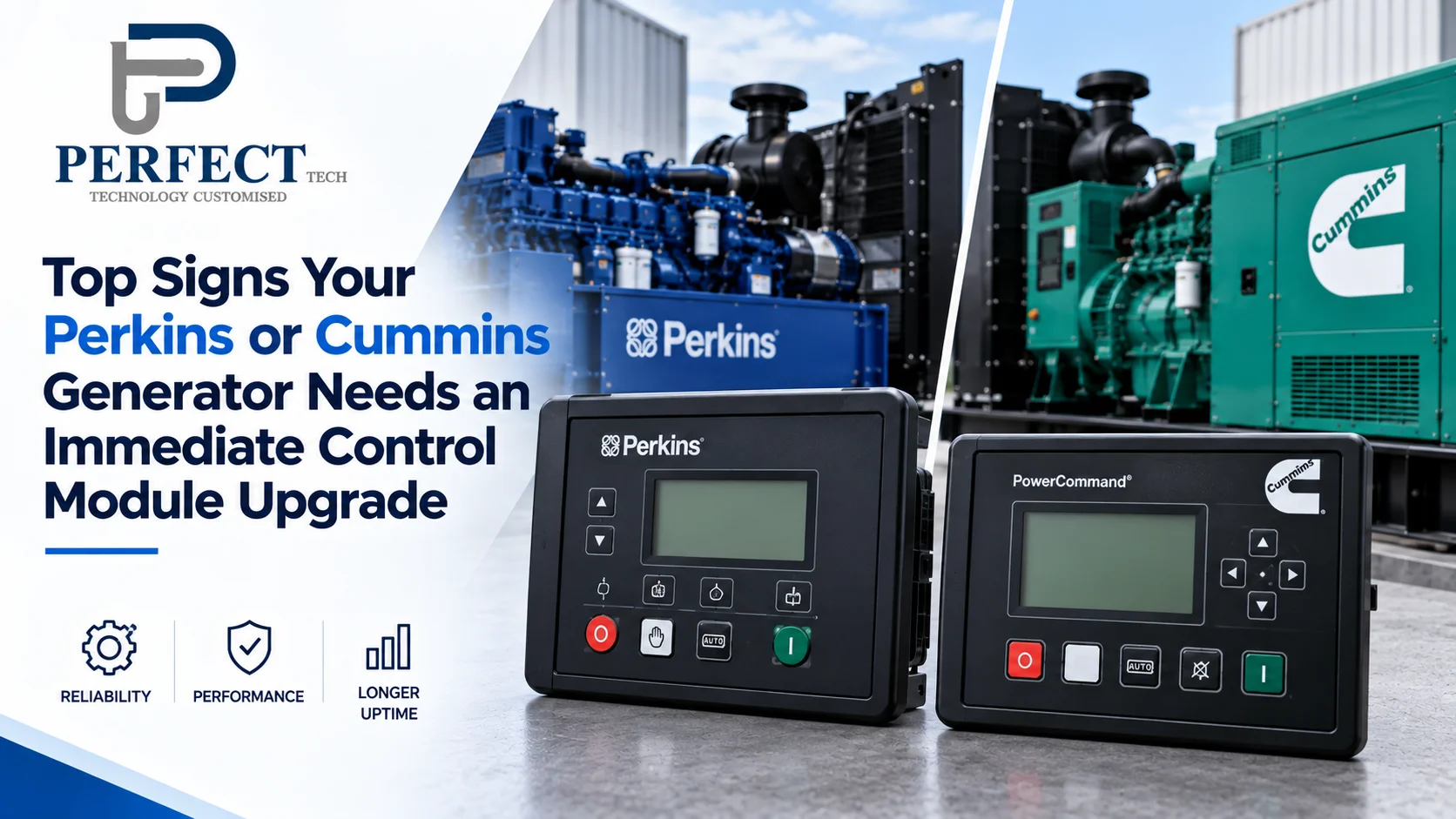
Industrial generators are expected to start reliably, respond quickly to changing loads, and provide stable power whenever the main electrical supply is unavailable. However, as a generator ages, its control system can become a major source of operational problems. Outdated controllers, intermittent alarms, communication failures, and limited monitoring capabilities can make it increasingly difficult for maintenance teams to diagnose faults and keep critical equipment running.
For facilities operating Perkins or Cummins generators, upgrading outdated generator control modules can improve monitoring, diagnostics, protection, and overall generator management. Recognizing the warning signs early can also help prevent unexpected downtime and expensive emergency repairs.
What Is a Generator Control Module?
A generator control module is the electronic control system responsible for monitoring and managing important generator functions.
Depending on the generator model and controller configuration, a control module may monitor:
- Engine speed
- Oil pressure
- Coolant temperature
- Battery voltage
- Generator voltage
- Frequency
- Engine operating hours
- Load conditions
- Warning and shutdown conditions
- Start and stop functions
- Fault codes and alarms
Modern controllers can also provide communication and remote-monitoring capabilities, allowing maintenance teams to obtain more detailed information about generator operation.
The exact functions vary according to the controller, engine, alternator, and generator set configuration.
Why Control Modules Matter for Perkins and Cummins Generators
Perkins and Cummins generator systems are used across industrial facilities, commercial buildings, telecommunications sites, construction operations, and other applications where dependable backup power is important.
The control module acts as an important interface between the generator’s engine, alternator, protection systems, and operator.
When the controller becomes outdated or unreliable, maintenance teams may experience:
- Difficulty identifying faults
- Inaccurate or incomplete operating information
- Intermittent alarms
- Communication problems
- Poor monitoring capability
- Limited diagnostic information
- Compatibility issues with newer monitoring systems
In critical applications, these problems can make relatively small generator faults much harder to diagnose.
10 Signs Your Generator Control Module May Need an Upgrade
1. Frequent False Alarms and Warning Messages
Repeated alarms are one of the most obvious signs that the control system requires investigation.
A generator may repeatedly report:
- Engine warnings
- Sensor faults
- Communication errors
- Voltage-related alarms
- Temperature warnings
- Battery-related faults
Not every alarm means the control module itself is defective. Sensors, wiring, power supplies, and other components should be tested first.
However, if repeated false alarms continue after the associated components have been checked, the controller may need further evaluation or replacement.
2. The Controller Display Is Failing
An aging controller may develop problems with its display or user interface.
Maintenance personnel might notice:
- Blank screens
- Flickering displays
- Missing characters
- Unresponsive buttons
- Difficult-to-read information
- Intermittent display operation
A damaged interface can prevent operators from quickly accessing important generator information.
For critical standby generators, reliable access to operating and alarm information is an important part of effective maintenance.
3. Fault Codes Are Difficult to Diagnose
Older controllers may provide limited diagnostic information compared with modern generator control systems.
If technicians repeatedly need external diagnostic equipment or manual testing simply to identify basic operating problems, an upgrade may provide more useful diagnostic capabilities.
Modern generator controllers can offer improved visibility into:
- Engine parameters
- Electrical measurements
- Alarm history
- Shutdown events
- Operating conditions
- Maintenance information
This can help maintenance teams reduce troubleshooting time.
4. Communication With Monitoring Systems Is Unreliable
Industrial facilities increasingly use centralized monitoring systems to track critical equipment.
An outdated generator controller may have limited communication capabilities or may not integrate easily with the facility’s current monitoring architecture.
Potential warning signs include:
- Lost communication
- Inconsistent data
- Limited remote monitoring
- Communication errors
- Difficulty integrating with facility management systems
Before upgrading, engineers should verify the communication requirements of the generator and the facility’s monitoring infrastructure.
5. The Generator Has an Outdated Control Platform
Technology changes over the operating life of a generator.
A generator that was installed many years ago may still have a controller designed around an older monitoring and communication environment.
If replacement components are becoming difficult to source or technical support for the existing controller is limited, a control-system upgrade may become part of the generator’s long-term maintenance strategy.
Why Component Availability Matters
Industrial spare-parts availability can directly affect maintenance schedules.
If a controller fails and the exact replacement is difficult to obtain, the generator could remain unavailable while procurement teams search for an appropriate component.
Maintaining accurate information about:
- Controller model
- Part number
- Generator model
- Engine model
- Serial number
- Wiring configuration
can make future replacement planning considerably easier.
6. Your Generator Requires Better Remote Monitoring
Remote monitoring can be particularly valuable for generators installed across multiple locations.
Instead of relying entirely on physical inspections, a compatible monitoring system may provide information about generator status and alarms remotely.
This can be useful for:
- Industrial plants
- Warehouses
- Telecommunications facilities
- Commercial buildings
- Remote installations
- Critical infrastructure
When considering an upgrade, ensure the new controller supports the required communication protocols and monitoring architecture.
7. The Controller Cannot Provide the Data Your Maintenance Team Needs
Modern predictive and preventive maintenance programs depend heavily on accurate operating information.
Maintenance teams may need access to parameters such as:
- Engine hours
- Coolant temperature
- Oil pressure
- Battery condition
- Generator voltage
- Frequency
- Load
- Start attempts
- Shutdown history
If the existing control module cannot provide the information required for your maintenance strategy, upgrading the controller may be worth considering.
8. Repeated Starting or Shutdown Problems Occur
Generator starting problems can have many possible causes.
Potential causes include:
- Weak batteries
- Starter motor problems
- Fuel-system issues
- Sensor faults
- Wiring problems
- Control logic problems
- Emergency-stop circuit issues
Therefore, a control module should not be replaced simply because a generator fails to start.
However, if electrical, mechanical, and fuel-system components have been checked and control-related faults continue to appear, the controller should be investigated.
A qualified technician should diagnose the complete starting circuit before recommending a replacement.
9. Your Generator Has New Equipment That the Existing Controller Cannot Support
Generator systems sometimes evolve after installation.
A facility may add:
- Remote monitoring
- Automatic transfer systems
- Building management integration
- Additional protection functions
- New communication infrastructure
- Advanced load-management requirements
The original controller may not support all of these requirements.
In such cases, a compatible control module upgrade can help bring the generator’s control architecture in line with the facility’s current requirements.
10. Replacement Parts for the Existing Controller Are Becoming Difficult to Source
This is an important consideration for procurement managers.
If the existing control module is obsolete or difficult to source, waiting until it completely fails can increase operational risk.
Instead, maintenance teams can proactively investigate:
- Current controller availability
- Approved replacement options
- Compatibility requirements
- Wiring modifications
- Software or configuration requirements
- Communication requirements
- Installation procedures
- Availability of technical documentation
Proactive planning can make an eventual controller replacement easier to manage.
Perkins and Cummins Generator Control Module Considerations
Perkins Generator Control Systems
Perkins-powered generator sets can use different control systems depending on the generator-set manufacturer, application, age, and configuration.
When sourcing a replacement controller, do not rely solely on the engine brand.
You should also identify:
- Generator-set manufacturer
- Engine model
- Engine serial number
- Generator model
- Existing controller model
- Controller part number
- Alternator information
- Existing wiring configuration
This information helps suppliers determine whether a proposed generator control module is appropriate for the specific system.
Cummins Generator Control Systems
Cummins generator sets can also use different control architectures depending on the generator model and application.
When replacing or upgrading a Cummins generator controller, procurement teams should verify the complete generator-set configuration rather than matching the engine brand alone.
Important information may include:
- Generator model
- Engine model
- Serial number
- Existing controller
- Controller part number
- Alternator specifications
- Communication requirements
- Existing control-panel configuration
A technically compatible replacement should be confirmed before installation.
Control Module Upgrade vs. Control Module Replacement
These terms are sometimes used interchangeably, but they can involve different requirements.
Control Module Replacement
A replacement generally involves installing a compatible controller in place of a failed or damaged unit.
This may be appropriate when:
- The existing controller has failed
- The same replacement is available
- No major functionality changes are required
- The existing system remains suitable
Control Module Upgrade
An upgrade can involve moving from an older controller to a newer compatible platform with additional functionality.
This may be considered when:
- The existing controller is obsolete
- Monitoring requirements have changed
- Communication capabilities are inadequate
- Replacement availability is becoming limited
- Improved diagnostics are required
The exact upgrade process depends on the generator and controller configuration.
What to Check Before Ordering a New Generator Control Module
Before contacting an industrial spare-parts supplier, collect as much technical information as possible.
Generator Information
- Generator manufacturer
- Generator model
- Generator serial number
- Rated power
- Output voltage
- Frequency
Engine Information
- Engine manufacturer
- Engine model
- Engine serial number
- Engine configuration
Controller Information
- Controller manufacturer
- Controller model
- Part number
- Serial number, if available
- Photographs of the controller
- Photographs of terminal connections
- Existing wiring diagram
Application Information
Also explain where the generator is being used and what functionality is required.
For example:
- Standby power
- Prime power
- Industrial plant
- Commercial facility
- Data center
- Construction site
- Remote installation
This information can help with accurate part identification.
Benefits of Upgrading Generator Control Modules
When technically appropriate, a modern control module can provide several operational benefits.
Improved Fault Diagnostics
More detailed alarms and event information can help technicians identify problems more efficiently.
Better Monitoring
Operators can obtain more useful information about generator performance and operating conditions.
Improved Communication
Compatible controllers may support integration with modern monitoring and facility-management systems.
Easier Maintenance Planning
Operating hours, fault history, and other information can support more organized maintenance programs.
Better Long-Term Spare Parts Planning
Replacing an obsolete controller with a supported platform can simplify future procurement, depending on the equipment configuration and supplier availability.
How to Avoid a Wrong Control Module Purchase
One of the most common mistakes in industrial spare-parts procurement is ordering a controller based on appearance or brand alone.
A controller can look similar to another unit while having different:
- Inputs
- Outputs
- Communication interfaces
- Software configuration
- Voltage requirements
- Wiring
- Control logic
- Generator compatibility
Always Verify Before Ordering
Before purchasing, confirm the:
Part number → Controller model → Generator model → Engine model → Wiring → Required functionality
This simple verification process can significantly reduce the risk of receiving an unsuitable component.
When Should You Upgrade Your Generator Control Module?
There is no universal replacement interval that applies to every generator controller.
Instead, consider an upgrade when several factors indicate that the existing system is becoming a maintenance or operational limitation.
These can include:
- Repeated unexplained controller faults
- Obsolete hardware
- Limited spare-parts availability
- Poor monitoring capabilities
- Communication limitations
- Failed display or interface
- Inadequate diagnostic information
- New monitoring requirements
- Difficulty obtaining technical support
A qualified generator technician should inspect the system before confirming that the controller is the root cause.
Generator Control Module Maintenance Best Practices
Even a modern controller requires proper maintenance.
Maintenance teams should:
- Keep control panels clean and dry.
- Inspect wiring and terminals regularly.
- Check for signs of overheating.
- Protect the controller from excessive moisture and contamination.
- Record alarm and shutdown events.
- Maintain accurate controller configuration records.
- Keep controller part numbers documented.
- Follow the generator manufacturer’s recommended maintenance procedures.
- Maintain critical spare components where appropriate.
Proper documentation is particularly valuable when multiple generator sets are operating across an industrial facility.
Why Accurate Spare-Part Identification Matters
For procurement managers, selecting a generator control module is not simply a matter of finding the cheapest available component.
The correct part should be evaluated against the complete equipment configuration.
Accurate identification can help prevent:
- Incorrect orders
- Installation delays
- Compatibility problems
- Extended equipment downtime
- Unnecessary return shipments
- Emergency procurement costs
Providing a clear controller nameplate photograph and generator information can make the sourcing process much more efficient.
How Perfect Tech Can Help With Generator Control Modules
Perfect Tech supports industrial spare-parts sourcing for businesses that need reliable components for generators and heavy equipment.
If you are looking for generator control modules for a Perkins or Cummins-powered generator, provide our team with the available technical information, including:
- Existing controller part number
- Generator model
- Engine model
- Serial number
- Controller photographs
- Nameplate information
- Wiring or technical documentation
Our team can assist with technical part identification and sourcing, helping procurement and maintenance teams identify the appropriate component for their equipment configuration.
Frequently Asked Questions
What is a generator control module?
A generator control module is an electronic control system that monitors and manages various generator functions, including engine parameters, alarms, starting, shutdowns, and electrical information.
Can an old generator controller be upgraded?
In many cases, an upgrade may be possible, but compatibility must be verified based on the generator, engine, alternator, wiring, and existing control architecture.
Does a Perkins engine require a specific control module?
The correct controller depends on the complete generator-set configuration rather than the engine brand alone. The generator model, existing controller, wiring, and required functionality should be checked.
Does a Cummins generator use the same control module across all models?
No. Cummins generator sets can use different control systems depending on the generator model, application, configuration, and production generation.
How do I identify the correct generator control module?
Start by recording the controller’s manufacturer, model, and part number. Then provide the generator model, engine model, serial number, and clear photographs of the existing controller and connections.
Should I replace a controller after one fault?
Not necessarily. A single fault can be caused by sensors, wiring, batteries, power supplies, or other components. The complete system should be diagnosed before replacing the control module.
Conclusion
A generator control module plays an important role in monitoring, protection, diagnostics, and operation. Warning signs such as repeated unexplained alarms, failing displays, communication problems, obsolete hardware, limited diagnostics, and difficult-to-source replacement parts can indicate that the existing control system requires closer evaluation.
For Perkins and Cummins generators, the correct solution depends on the complete generator configuration—not simply the engine brand or physical appearance of the controller.
If your facility needs a replacement or upgrade, contact Perfect Tech for technical assistance and part matching. Send us your controller part number, generator model, engine details, or a clear photograph of the existing unit, and our team can help you identify and source the appropriate generator control modules for your application.
