
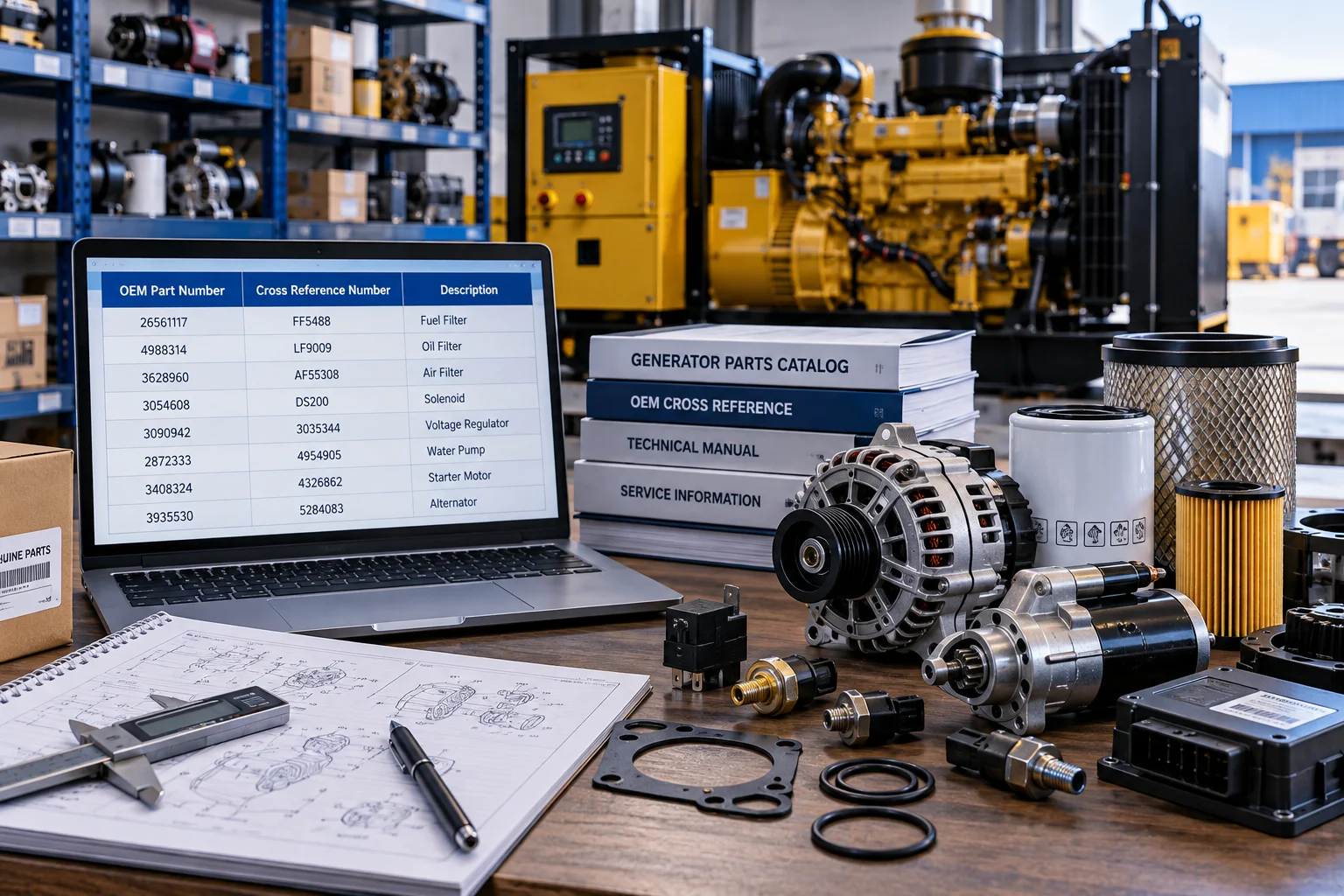
Finding the correct replacement component for an industrial generator can become challenging when the original part is discontinued, difficult to source, or listed under a different part number. Generator manufacturers, distributors, and aftermarket suppliers may use different numbering systems for similar components, making accurate identification an important part of the procurement process.
Generator part number cross-referencing provides a practical way to identify alternative or replacement components by comparing original part numbers with compatible manufacturer, supplier, or replacement numbers. However, cross-referencing should never be based on the number alone. Technical specifications, generator model, engine configuration, dimensions, electrical ratings, and application must also be verified.
For maintenance teams, procurement managers, and generator operators, a structured cross-referencing process can reduce ordering mistakes, shorten sourcing time, and help locate hard-to-find generator components.
What Is Part Number Cross-Referencing?
Part number cross-referencing is the process of comparing a known component number with other numbers that may represent the same or a compatible part.
For example, an industrial generator component may have:
- An OEM part number
- A manufacturer replacement number
- A distributor number
- An aftermarket part number
- A superseded part number
- A regional or catalog-specific number
The purpose of cross-referencing is to determine whether these numbers refer to the same component or an approved replacement.
This process is particularly useful when the original part number is no longer available through the usual supplier.
Why Generator Part Numbers Can Be Difficult to Identify
Industrial generators often contain hundreds of individual components. Many parts can look similar while having different specifications or applications.
A sensor, relay, solenoid, controller, filter, gasket, or electrical component may have a part number that changes because of:
- Manufacturer revisions
- Product updates
- Engine configuration
- Generator model
- Production year
- Regional specifications
- Supplier catalog changes
- Component supersession
This means that simply finding a similar-looking component is not enough to confirm compatibility.
Why Accurate Cross-Referencing Matters
Ordering the wrong generator component can create unnecessary costs and delays.
If an incorrect part arrives, the maintenance team may need to return it, reorder the correct component, and keep the generator out of service while waiting.
For standby generators, industrial power systems, and critical equipment, these delays can affect maintenance schedules and operational availability.
Accurate generator part number cross-referencing helps procurement teams establish a stronger connection between the original component and a suitable replacement.
Start With the Original Part Number
The first step is to collect the most accurate information available about the existing component.
Look for the part number on:
- Component labels
- Manufacturer plates
- Packaging
- Maintenance records
- Previous purchase invoices
- Equipment manuals
- Parts catalogs
- Service documentation
Part numbers should be recorded exactly as shown. Differences involving letters, numbers, prefixes, suffixes, and revision codes can be significant.
For example, two numbers that appear almost identical may represent different versions of a component.
Identify the Generator and Engine Model
A part number should be evaluated in the context of the equipment where it is installed.
Record details such as:
Generator information
- Generator manufacturer
- Generator model
- Generator serial number
- Rating
- Production information where available
Engine information
- Engine manufacturer
- Engine model
- Engine serial number
- Configuration
- Application
This information provides additional confirmation when checking a replacement component.
Understand OEM and Superseded Part Numbers
Manufacturers sometimes replace an older part number with a newer number.
This is known as part number supersession.
For example, an older component may be replaced by an updated version because of:
- Design improvements
- Material changes
- Manufacturing changes
- Availability issues
- Product standardization
A newer number may therefore be the manufacturer’s current replacement for an older component.
However, procurement teams should confirm the relationship using reliable technical documentation rather than assuming that a newer number is automatically compatible.
Check Technical Specifications
Part number matching is only one part of the verification process.
Technical specifications should also be compared.
Depending on the component, relevant specifications may include:
- Voltage
- Current
- Frequency
- Resistance
- Pressure rating
- Temperature range
- Thread size
- Connector type
- Dimensions
- Mounting arrangement
- Material
- Flow capacity
- Operating environment
For electrical generator components, even a small difference in voltage or connector configuration can make a component unsuitable.
For mechanical components, dimensions, tolerances, materials, and mounting specifications can be equally important.
Cross-Referencing Generator Sensors
Sensors are common examples of components that require careful identification.
A temperature sensor, pressure sensor, speed sensor, or coolant sensor may have a similar appearance to another component while having different electrical characteristics.
When cross-referencing a sensor, verify:
- Original part number
- Sensor type
- Operating range
- Thread specification
- Connector
- Electrical characteristics
- Engine application
This helps prevent the common mistake of selecting a sensor based only on physical appearance.
Cross-Referencing Generator Electrical Components
Generators also contain many electrical components that may require replacement.
These can include:
- Relays
- Solenoids
- Contactors
- Voltage regulators
- Control modules
- Sensors
- Circuit protection components
- Battery chargers
- Control panel components
For electrical components, procurement teams should pay particular attention to electrical ratings and connection configurations.
A visually similar replacement is not necessarily an electrically compatible replacement.
Cross-Referencing Mechanical Components
Mechanical components also require detailed verification.
Common examples include:
- Gaskets
- Seals
- Bearings
- Bushings
- Belts
- Pulleys
- Couplings
- Mounting components
- Engine components
For these parts, measurements and application information can be especially useful.
Important details may include outside diameter, inside diameter, thickness, length, thread type, material, and mounting configuration.
Use Multiple Identification Sources
A reliable cross-reference should ideally be supported by more than one source.
Useful sources can include:
Manufacturer Documentation
OEM parts catalogs, technical manuals, and service documentation can provide valuable information about original and replacement part numbers.
Supplier Catalogs
Established suppliers may maintain cross-reference databases covering multiple manufacturers and product ranges.
Previous Procurement Records
Historical invoices and previous maintenance purchases can help identify components that have already been successfully used on the same equipment.
Component Identification
Labels, markings, dimensions, and technical specifications can provide additional confirmation when documentation is incomplete.
Beware of “Looks the Same” Parts
One of the most common procurement mistakes is selecting a component because it looks identical to the original.
Two components can have:
- Similar dimensions
- Similar housings
- Similar connectors
- Similar mounting points
while having different internal specifications.
This is particularly important for control modules, sensors, electrical components, and engine-related parts.
Physical similarity should therefore be treated as an identification clue rather than final proof of compatibility.
Handling Discontinued Generator Components
Hard-to-find components are often discontinued because manufacturers update equipment designs or stop producing older product lines.
When the original component is discontinued, procurement teams can investigate:
- Superseded OEM numbers
- Approved replacement components
- Manufacturer equivalents
- Compatible aftermarket options
- Refurbished components where appropriate
- Alternative suppliers with existing inventory
The replacement should still be verified against the equipment application before purchase.
Creating a Generator Parts Cross-Reference Record
Organizations that regularly maintain generators can benefit from maintaining their own parts database.
A useful record can contain:
| Information | Example |
|---|---|
| Equipment | Industrial Generator |
| Engine Model | Engine model number |
| Original Part Number | OEM number |
| Replacement Number | Current number |
| Component Type | Sensor / Relay / Filter |
| Manufacturer | Component manufacturer |
| Application | Generator model |
| Verification Status | Confirmed |
| Supplier | Approved supplier |
Maintaining this information can make future procurement significantly faster.
Common Mistakes in Part Number Cross-Referencing
Relying Only on Google Search Results
Search engines can help locate information, but search results should not be treated as technical confirmation.
Ignoring Suffixes
Letters or numbers at the end of a part number may indicate an important revision or application difference.
Not Checking Equipment Compatibility
A component may be genuine but still be intended for a different generator or engine configuration.
Using an Unverified Aftermarket Equivalent
An aftermarket component should be evaluated based on specifications and application compatibility rather than price alone.
Ordering Without Technical Verification
For critical generator components, procurement teams should confirm the part before placing the final order.
How a Spare Parts Supplier Can Help
An experienced industrial spare parts supplier can help procurement teams identify difficult components by combining part-number information with equipment specifications.
When requesting a cross-reference, provide as much information as possible, including:
- Original part number
- Generator model
- Engine model
- Serial number
- Component photographs
- Technical specifications
- Existing supplier information
- Required quantity
The more complete the information, the easier it becomes to investigate potential replacement options.
A Practical Cross-Referencing Workflow
A simple workflow can make the process more consistent:
Step 1: Record the original part number.
Step 2: Identify the generator and engine model.
Step 3: Check OEM documentation for current or superseded numbers.
Step 4: Compare technical specifications.
Step 5: Check reputable supplier cross-reference information.
Step 6: Verify dimensions, connections, and application.
Step 7: Confirm the replacement before placing the order.
This approach reduces the risk of relying on incomplete information.
The Role of Accurate Procurement in Generator Maintenance
Generator maintenance depends on having the right components available when they are needed. Delays in identifying a difficult part can extend equipment downtime and complicate maintenance planning.
Effective generator part number cross-referencing helps bridge the gap between older equipment documentation and currently available replacement components.
It is particularly valuable for organizations maintaining older generator fleets where original components may no longer be readily available.
Conclusion
Navigating hard-to-find generator components requires more than searching for a similar part number. Generator part number cross-referencing should combine OEM information, equipment details, technical specifications, dimensions, component markings, and supplier verification.
A structured approach helps procurement teams identify superseded numbers, investigate compatible replacement options, and reduce the risk of ordering incorrect components.
For industrial generator operators and maintenance teams, maintaining accurate part records and working with knowledgeable spare parts suppliers can make difficult component sourcing faster and more reliable.
Perfect Tech supports industrial equipment requirements with generator spare parts, diesel engine components, electrical products, mechanical parts, and other industrial replacement components.
