
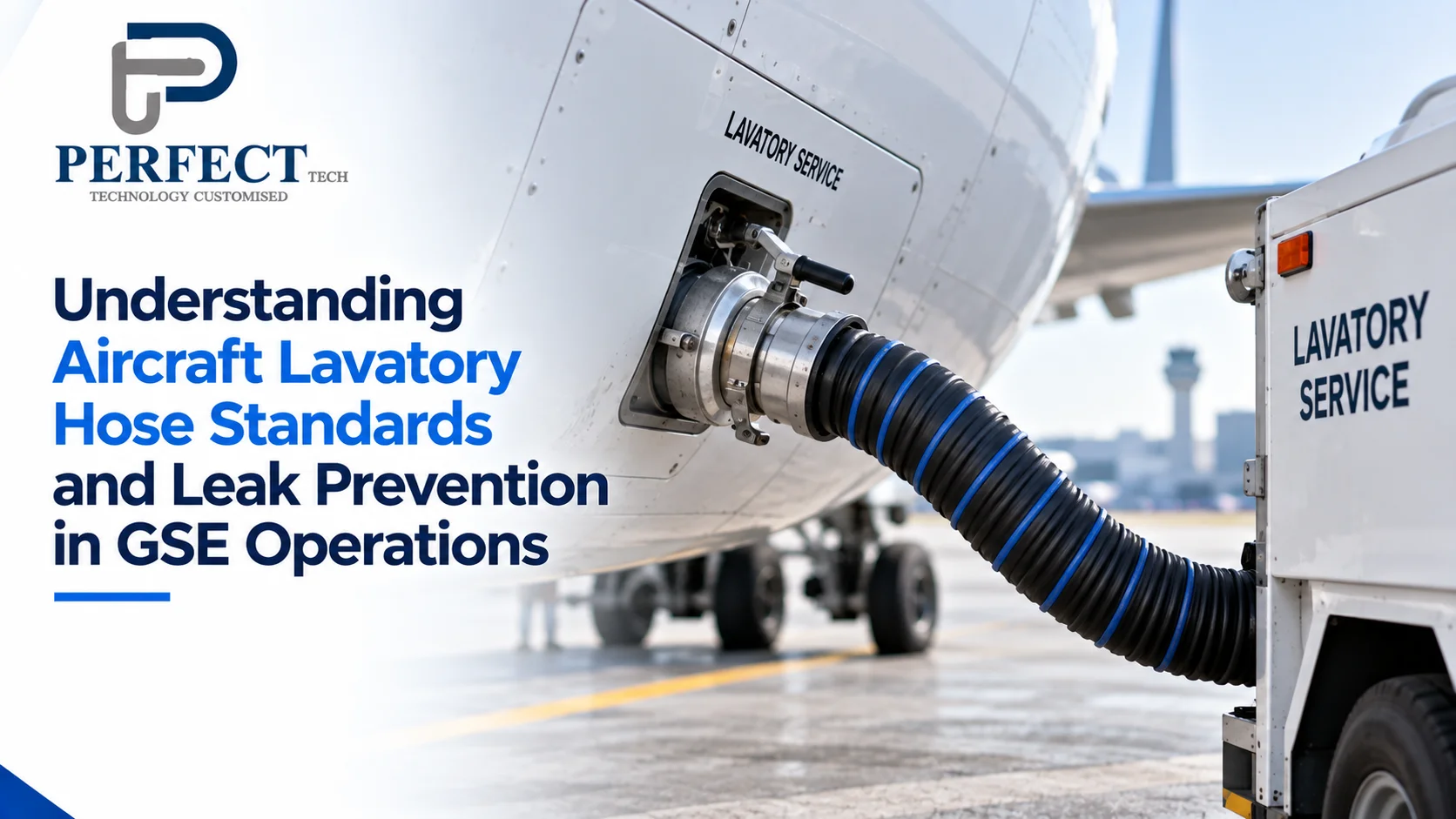
Aircraft lavatory servicing is a routine but critical part of airport ground operations. During aircraft turnaround, lavatory service equipment must safely remove waste from the aircraft and transfer it to the appropriate servicing system without leakage, contamination, or unnecessary delays.
At the center of this process are durable hoses, connectors, and couplings. A properly selected aircraft lavatory hose coupling helps maintain a secure connection between the aircraft service point and the ground support equipment (GSE), while suitable hose construction helps withstand repeated handling, bending, and exposure to demanding airport environments.
For airport operators, GSE fleet managers, maintenance engineers, and aviation procurement teams, understanding hose specifications and leak-prevention practices can help improve equipment reliability and reduce avoidable servicing problems.
What Is an Aircraft Lavatory Hose?
An aircraft lavatory hose is a flexible hose used by lavatory service vehicles or ground equipment to connect with the aircraft’s lavatory servicing system.
Depending on the GSE configuration, the hose assembly may include:
- Flexible service hose
- Aircraft-side coupling
- Ground-equipment connection
- Clamps
- Gaskets or seals
- Protective covers
- Valves or related fittings
The complete assembly must be suitable for the intended aircraft and servicing equipment.
Why Aircraft Lavatory Hose Quality Matters
Lavatory servicing takes place frequently across airport operations. Hoses may be connected, disconnected, moved, stored, and cleaned many times during their service life.
Poor-quality or unsuitable components can contribute to:
- Fluid leakage
- Difficult connections
- Damaged fittings
- Premature hose failure
- Servicing delays
- Equipment downtime
- Increased maintenance costs
For this reason, hose selection should consider technical compatibility, durability, flexibility, connection security, and the operating environment.
Understanding Aircraft Lavatory Hose Couplings
The aircraft lavatory hose coupling provides the connection between the hose and the aircraft servicing point or associated GSE.
The coupling must be correctly matched to the application.
Important considerations can include:
- Connection size
- Coupling configuration
- Locking mechanism
- Seal design
- Material
- Hose compatibility
- Aircraft/GSE interface
- Operating environment
A coupling that appears physically similar to an existing component should not automatically be treated as a suitable replacement.
Technical specifications should be verified before procurement.
Why Coupling Compatibility Is Important
An incompatible coupling may cause:
- Poor sealing
- Difficult installation
- Unintentional disconnection
- Leakage
- Damage to the service connection
- Increased wear
For airport maintenance teams, confirming the correct coupling specification before ordering can help prevent unnecessary downtime.
Common Causes of Aircraft Lavatory Hose Leaks
Leaks can originate from several points in the servicing system.
1. Damaged Hose Material
Repeated dragging, bending, twisting, or contact with abrasive surfaces can damage the hose.
Inspect for:
- Cracks
- Cuts
- Abrasion
- Bulging
- Flattening
- Kinks
- Surface deterioration
A hose showing significant structural damage should be evaluated according to the manufacturer’s maintenance criteria.
2. Worn Coupling Seals
Seals and gaskets can deteriorate through repeated use, contamination, temperature changes, or age.
A worn seal may result in leakage even when the hose itself appears to be in good condition.
Inspect sealing surfaces for:
- Cracks
- Flattening
- Hardening
- Deformation
- Contamination
Replace seals using components specified for the particular coupling.
3. Loose or Damaged Connections
Repeated servicing can eventually affect clamps, fittings, and connection hardware.
Maintenance teams should check for:
- Loose clamps
- Damaged threads
- Deformed fittings
- Misalignment
- Worn locking mechanisms
Connections should be installed and secured according to the applicable equipment manufacturer’s procedures.
4. Incorrect Hose Installation
A hose installed under excessive tension can place unnecessary stress on the coupling.
Avoid:
- Sharp bends near the coupling
- Excessive twisting
- Pulling the hose sideways
- Excessive stretching
- Supporting the hose incorrectly
The hose should be positioned so that the coupling is not carrying unnecessary mechanical load.
Aircraft Lavatory Hose Standards and Specifications
There is no single specification that automatically applies to every aircraft lavatory hose application.
Requirements can vary according to:
- Aircraft type
- Lavatory service vehicle
- GSE manufacturer
- Hose diameter
- Connection design
- Operating environment
- Applicable aviation and airport requirements
When sourcing a replacement, procurement teams should identify the specific aircraft/GSE application and verify the applicable manufacturer documentation and requirements.
Key Hose Specifications to Verify
Before purchasing a replacement hose, check:
Internal Diameter
The internal diameter affects flow characteristics and must be appropriate for the servicing system.
Length
The hose should provide sufficient reach without creating excessive slack or handling problems.
Material
Material selection should be appropriate for the intended fluid, temperature, cleaning procedures, and environmental conditions.
Flexibility
The hose should allow practical positioning without excessive bending or kinking.
Reinforcement
Depending on the application, reinforcement may improve resistance to pressure, bending, and mechanical stress.
End Connections
The hose ends must be compatible with the required coupling and GSE connection.
Preventing Aircraft Lavatory Hose Leaks
Leak prevention begins before the equipment is used.
Perform Pre-Use Inspections
Operators should visually inspect the hose assembly before servicing.
Check:
- Hose surface
- Couplings
- Seals
- Clamps
- Connection points
- Locking mechanisms
- Visible contamination
- Signs of leakage
Any abnormal condition should be reported according to the airport’s GSE maintenance procedure.
Avoid Excessive Bending
Sharp bends can place stress on the hose wall and coupling.
Where applicable, maintain the manufacturer’s recommended bend radius.
Avoid forcing the hose into a position that creates permanent deformation.
Protect Hoses From Abrasion
Do not routinely drag hoses across rough surfaces when this can be avoided.
Pay particular attention to areas where hoses contact:
- Concrete
- Metal edges
- Vehicle components
- Sharp corners
- Other GSE
Repeated abrasion can gradually weaken the outer surface.
Keep Coupling Surfaces Clean
Dirt or debris around a coupling can interfere with proper sealing.
Before connecting:
- Inspect the coupling.
- Clean the connection area using the approved procedure.
- Check the seal.
- Confirm alignment.
- Secure the coupling correctly.
- Check for leakage during operation.
Cleaning procedures should follow the applicable equipment and airport requirements.
Proper Hose Storage
Storage can have a significant effect on hose service life.
Avoid storing hoses:
- Under heavy equipment
- With severe bends
- Around sharp edges
- In excessive heat
- In conditions outside the manufacturer’s recommendations
Where the manufacturer specifies a minimum storage bend radius or coiling procedure, maintenance personnel should follow it.
Proper storage helps reduce unnecessary stress between servicing operations.
Aircraft Lavatory Hose Inspection Checklist
A simple inspection process can help maintenance teams identify problems early.
Hose Condition
Check for:
- Cracks
- Cuts
- Abrasion
- Bulging
- Flattening
- Excessive stiffness
Coupling Condition
Check:
- Locking mechanism
- Connection surfaces
- Threads, where applicable
- Deformation
- Corrosion
- Damage
Seals
Check for:
- Cracking
- Hardening
- Flattening
- Missing components
- Contamination
Connections
Check:
- Alignment
- Clamps
- Fasteners
- Leakage
- Unusual movement
Document significant defects and follow the applicable maintenance procedure before returning damaged equipment to service.
How to Identify an Aircraft Lavatory Hose Coupling
When sourcing a replacement aircraft lavatory hose coupling, relying on appearance alone can lead to an incorrect order.
Collect as much information as possible.
Equipment Information
- GSE manufacturer
- GSE model
- Vehicle serial number
- Aircraft application
Existing Component Information
- Coupling part number
- Manufacturer
- Hose diameter
- Connection size
- Coupling photographs
- Seal/gasket information
Technical Information
Where available, provide:
- Technical datasheet
- Equipment manual
- Connection drawing
- Existing hose specification
This information can help suppliers perform more accurate technical part matching.
Common Aircraft Lavatory Hose Maintenance Mistakes
Using the Wrong Coupling
A coupling that does not match the aircraft or GSE connection can create leakage and operational problems.
Better approach: Verify the exact connection specification before ordering.
Ignoring Small Leaks
A minor leak can indicate a deteriorating seal, damaged hose, or connection problem.
Better approach: Investigate leaks promptly rather than waiting for the problem to become more severe.
Over-Bending the Hose
Repeated sharp bends can accelerate hose deterioration.
Better approach: Use the hose within its recommended bend radius.
Poor Storage
Leaving hoses exposed to unnecessary mechanical stress can shorten their service life.
Better approach: Follow the manufacturer’s storage and handling recommendations.
Replacing Only the Hose
Sometimes the hose is replaced while an aging coupling or seal remains in service.
Better approach: Inspect the complete hose assembly, including couplings, seals, clamps, and fittings.
Choosing Replacement Aircraft Lavatory Hoses
Procurement teams should evaluate replacement hoses based on the complete application.
Consider:
- Aircraft compatibility
- GSE compatibility
- Hose diameter
- Hose length
- Coupling type
- Material
- Flexibility
- Environmental exposure
- Cleaning requirements
- Manufacturer specifications
The lowest purchase price should not be the only consideration. Compatibility and service suitability are essential for aviation GSE components.
Why Preventive Maintenance Reduces GSE Downtime
Lavatory servicing equipment is part of the aircraft turnaround process. If a service vehicle is unavailable because of a failed hose or coupling, another unit may need to be deployed.
A preventive maintenance program can help fleet managers:
- Identify damaged hoses early
- Replace worn seals
- Track component life
- Maintain critical spare parts
- Reduce emergency repairs
- Improve equipment availability
Maintenance records should include component replacement dates and part numbers where possible.
Spare-Part Planning for Aircraft Lavatory Equipment
Airport operators should identify critical consumable and replacement components based on fleet requirements.
Potential stock items may include:
- Lavatory hoses
- Couplings
- Seals
- Gaskets
- Clamps
- Valves
- Hose fittings
- Related GSE components
Inventory levels should reflect equipment criticality, historical failure rates, supplier lead times, and operational requirements.
How Perfect Tech Can Help
Perfect Tech supports industrial and aviation spare-parts sourcing for GSE operators and maintenance teams.
If you need an aircraft lavatory hose coupling, replacement hose, or related GSE component, provide:
- Existing part number
- GSE manufacturer and model
- Aircraft application
- Hose diameter
- Hose length
- Coupling photographs
- Nameplate information
- Technical documentation
Our team can assist with technical part matching and sourcing based on the available equipment information.
This can help procurement teams reduce the risk of ordering an unsuitable component and simplify the process of identifying aviation GSE spare parts.
Frequently Asked Questions
What is an aircraft lavatory hose coupling?
An aircraft lavatory hose coupling is a connection component used to securely connect a lavatory servicing hose to the aircraft servicing interface or associated ground equipment.
What causes aircraft lavatory hose leaks?
Common causes can include damaged hose material, worn seals, loose connections, coupling damage, excessive bending, abrasion, and incorrect installation.
How often should lavatory service hoses be inspected?
Inspection frequency should follow the GSE manufacturer’s recommendations and the airport operator’s maintenance procedures. Visual checks should also be performed before use where required.
How do I find the correct aircraft lavatory hose coupling?
Start with the existing coupling part number and GSE information. Provide photographs, hose dimensions, connection details, aircraft application, and technical documentation where available.
Can any coupling of the same size be used?
No. Physical size alone does not establish compatibility. Coupling design, sealing method, connection configuration, material, and application should be verified.
When should an aircraft lavatory hose be replaced?
Replacement depends on its condition, manufacturer requirements, operating environment, and service history. Cracks, significant abrasion, deformation, leakage, or other structural damage should be evaluated promptly.
Conclusion
Reliable aircraft lavatory servicing depends on properly maintained hoses, couplings, seals, and connections. A correctly specified aircraft lavatory hose coupling helps create a secure connection, while appropriate hose construction and preventive maintenance can reduce leakage and premature component failure.
Airport GSE teams should regularly inspect hoses for abrasion, cracking, deformation, and leakage while also checking couplings, seals, clamps, and connection points. Accurate spare-part identification is equally important when replacement components are required.
If you need an aircraft lavatory hose coupling or replacement GSE hose, contact Perfect Tech. Share your existing part number, equipment details, dimensions, or clear photographs, and our team can assist with technical part matching and aviation spare-parts sourcing.
