
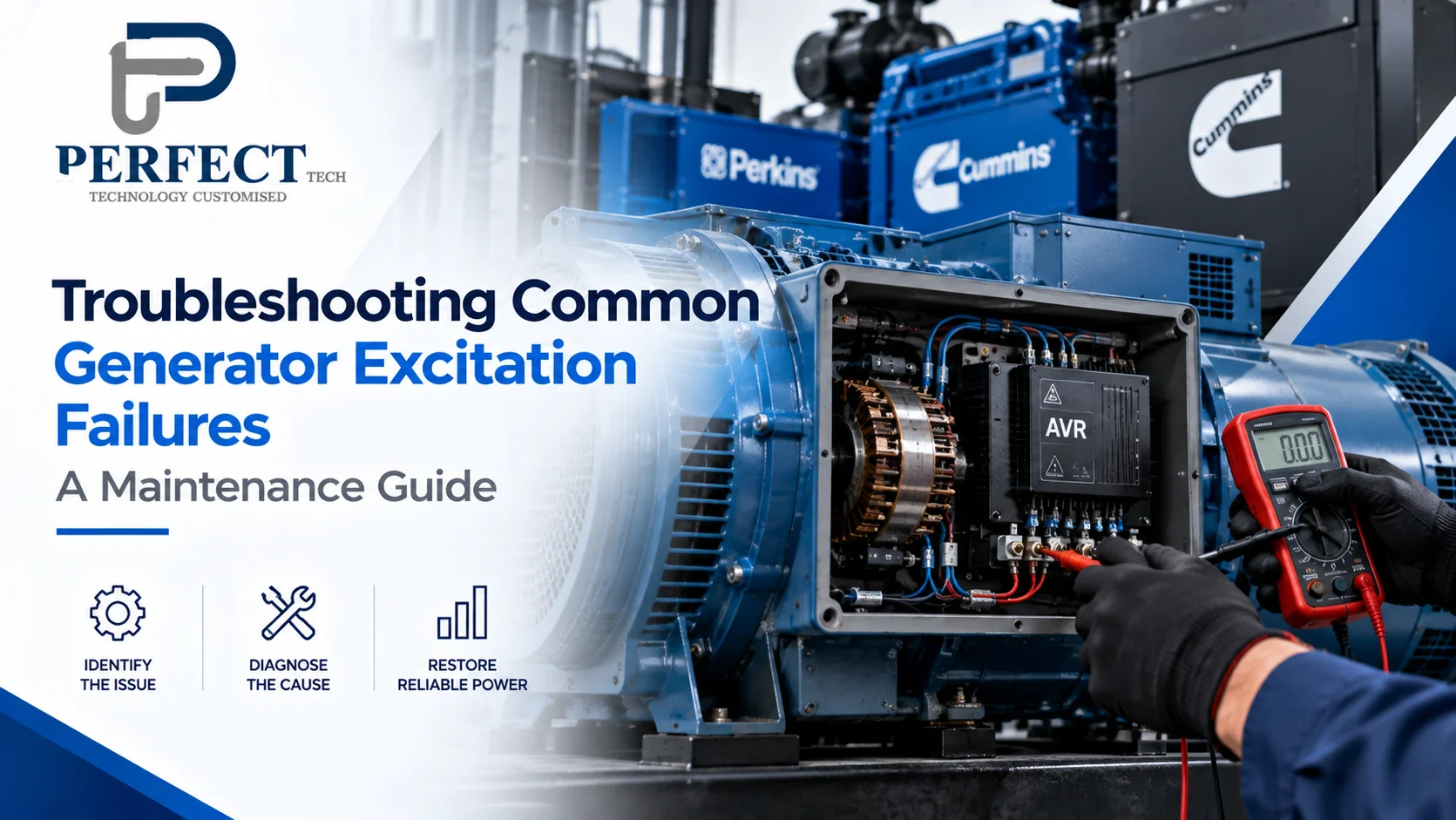
Generator excitation problems can quickly turn a reliable power system into a source of unexpected downtime. Symptoms such as low generator voltage, failure to build voltage, unstable output, poor load response, or repeated AVR alarms can indicate a problem within the excitation system.
For maintenance engineers, diagnosing generator excitation failures requires more than replacing the Automatic Voltage Regulator (AVR). The fault may originate from the AVR, exciter, field winding, rotating diodes, wiring, sensing circuit, or another part of the generator’s excitation system.
This maintenance guide explains the most common excitation problems, their possible causes, and practical troubleshooting steps for industrial generator systems.
What Is a Generator Excitation System?
The excitation system provides the magnetic field required for an alternator to generate electrical voltage.
In a typical generator, the excitation system works together with:
- Automatic Voltage Regulator (AVR)
- Exciter
- Main rotor field
- Main stator
- Rotating rectifier or diode assembly
- Excitation wiring
- Voltage sensing circuits
- Permanent Magnet Generator (PMG), where fitted
The AVR monitors generator output and controls excitation to maintain the required terminal voltage.
When any part of this system fails, the generator may be unable to build or maintain normal voltage.
Common Symptoms of Generator Excitation Failures
Before troubleshooting, maintenance personnel should identify the exact symptom.
Common signs include:
- Generator fails to build voltage
- Output voltage is significantly below rated voltage
- Generator voltage fluctuates
- Voltage collapses when a load is connected
- AVR alarms or protection activates
- Generator produces unstable voltage
- Excitation current is unusually high or low
- Generator trips during load application
- Voltage remains high or cannot be controlled
- Generator operates normally at no load but becomes unstable under load
Accurate symptom identification helps narrow down the possible causes.
1. Generator Fails to Build Voltage
One of the most common excitation problems is a generator that starts normally but produces little or no output voltage.
Possible Causes
Potential causes include:
- AVR failure
- Loss of residual magnetism
- Excitation supply failure
- Open excitation circuit
- Damaged field winding
- Faulty rotating diodes
- PMG failure
- Incorrect AVR wiring
- Blown fuse or protection device
- Fault in the voltage-sensing circuit
Troubleshooting Steps
Start by checking the generator’s basic electrical condition.
Inspect:
- AVR power supply
- AVR connections
- Voltage-sensing terminals
- Excitation wiring
- Field circuit continuity
- Fuses and protection devices
- PMG output, if applicable
- Rotating rectifier components
Do not immediately replace the AVR without testing the rest of the excitation circuit.
2. Low Generator Output Voltage
A generator may build voltage but produce output significantly below its rated value.
Possible causes include:
- Incorrect AVR adjustment
- Weak excitation
- Faulty voltage sensing
- AVR malfunction
- Exciter problems
- Field winding issues
- Incorrect generator configuration
- Poor electrical connections
Maintenance Checks
Compare the measured generator voltage against the manufacturer’s specified values.
Then inspect:
- AVR sensing voltage
- AVR supply voltage
- Excitation output
- Field resistance
- Terminal connections
- Generator frequency
A frequency problem can also influence voltage regulation, so generator speed and frequency should be verified during diagnosis.
3. Unstable Generator Voltage
Voltage fluctuations can be particularly problematic when a generator supplies sensitive electrical equipment.
Potential causes include:
- AVR instability
- Incorrect AVR stability settings
- Loose wiring
- Poor sensing connections
- Damaged sensing components
- Excitation system problems
- Rapid load changes
- Incorrect AVR configuration
What to Check
Maintenance engineers should monitor generator voltage both at no load and under controlled load conditions.
Check for:
- Loose terminals
- Damaged cables
- Incorrect sensing connections
- AVR adjustment issues
- Unusual excitation-current fluctuations
- Generator frequency instability
If the generator becomes unstable only after a load is applied, investigate both the excitation system and the characteristics of the connected load.
4. Voltage Drops When Load Is Applied
A generator that maintains acceptable voltage at no load but experiences a major voltage drop after load application may have an excitation or generator-performance problem.
Potential causes include:
- Insufficient excitation
- AVR malfunction
- Exciter limitation
- Rotating diode failure
- Generator overload
- Sudden load increase
- Nonlinear electrical loads
- Engine speed reduction
Important Diagnostic Point
Do not automatically assume the AVR is responsible.
A significant load increase can cause temporary voltage and frequency changes. If the voltage does not recover according to the generator’s expected response, investigate the excitation system, engine performance, alternator condition, and load characteristics.
5. Excessive Excitation Current
Excessive excitation can indicate that the generator is attempting to maintain voltage under abnormal operating conditions.
Possible causes include:
- Incorrect AVR settings
- Voltage-sensing problems
- Overloaded generator
- Alternator fault
- Field winding problems
- Incorrect system configuration
- Excitation-control malfunction
Continuous operation with excessive excitation can create additional thermal stress.
Maintenance teams should compare excitation measurements with the generator manufacturer’s specifications before making adjustments.
6. AVR Is Not Receiving the Correct Sensing Voltage
The AVR depends on voltage feedback to regulate generator output.
If the sensing signal is missing or incorrect, the regulator may not control excitation correctly.
Possible causes include:
- Broken sensing wire
- Loose terminal
- Incorrect wiring
- Blown fuse
- Damaged sensing transformer
- Incorrect connection
- AVR sensing-circuit failure
Recommended Inspection
Verify the sensing voltage at the appropriate terminals according to the manufacturer’s wiring diagram.
Never assume that terminal positions are identical between different AVR models.
7. Rotating Diode Failure
Brushless alternators commonly use rotating rectifier assemblies to convert AC excitation into DC for the main rotor field.
A failed rotating diode can cause excitation problems even when the AVR itself is operating correctly.
Possible symptoms include:
- Low output voltage
- Poor voltage regulation
- Excessive excitation
- Voltage instability
- Reduced generator performance
- Abnormal heating
Maintenance Approach
The rotating diode assembly should be inspected and electrically tested according to the alternator manufacturer’s service procedure.
If one diode fails, technicians should assess the complete rectifier assembly rather than replacing components without understanding the reason for the failure.
8. Exciter Winding Problems
The exciter is an important part of a brushless generator’s excitation system.
Problems with exciter windings can reduce or eliminate the excitation available to the main rotor.
Possible causes include:
- Open winding
- Shorted winding
- Insulation deterioration
- Overheating
- Mechanical damage
- Contamination
- Electrical overload
Resistance and insulation tests should be performed using the manufacturer’s recommended procedures and test limits.
9. Main Rotor Field Problems
The main rotor field winding creates the magnetic field required for generator operation.
A problem in the rotor field circuit can produce symptoms similar to an AVR failure.
Potential issues include:
- Open field circuit
- Shorted turns
- Insulation damage
- Poor connections
- Overheating
- Mechanical damage
If AVR output appears normal but generator voltage remains abnormal, the field circuit should be investigated.
10. PMG Excitation Problems
Some industrial alternators use a Permanent Magnet Generator (PMG) as an independent excitation power source for the AVR.
A PMG-related fault can cause excitation problems even when the main generator appears mechanically healthy.
Possible causes include:
- PMG winding fault
- Damaged wiring
- Connection failure
- Mechanical damage
- Incorrect AVR compatibility
- PMG output outside the specified range
If a generator is equipped with a PMG, its output should be checked according to the alternator manufacturer’s technical documentation.
Generator Excitation Troubleshooting Procedure
A systematic troubleshooting process is generally more effective than replacing components based on symptoms alone.
Step 1: Confirm the Generator’s Basic Operating Conditions
Before examining the excitation system, verify:
- Engine starts correctly
- Engine reaches the correct operating speed
- Frequency is within the specified range
- Generator is not overloaded
- Emergency-stop circuits are reset
- Batteries and starting system are functioning correctly
Step 2: Inspect the AVR
Check the AVR for:
- Physical damage
- Burn marks
- Loose connections
- Overheating
- Damaged terminals
- Incorrect configuration
- Fault indications
Record the AVR model and part number before considering replacement.
Step 3: Check Voltage Sensing
Verify that the AVR is receiving the correct sensing signal.
Inspect:
- Sensing wires
- Fuses
- Terminal connections
- Transformers, where applicable
- Connector condition
Step 4: Check Excitation Supply
Determine where the AVR receives its excitation power.
Depending on the alternator design, this may come from:
- Generator output
- Auxiliary winding
- PMG
- Another excitation source
The exact measurement points depend on the generator design.
Step 5: Inspect the Excitation Circuit
Check:
- AVR output
- Exciter
- Field wiring
- Rotor field
- Rotating rectifier
- Diodes
- Connections
Follow the generator manufacturer’s service documentation for appropriate electrical tests.
Step 6: Check the Load
If the generator performs correctly without a load but becomes unstable under load, examine:
- Load percentage
- Motor starting loads
- Nonlinear loads
- Sudden load changes
- Power factor
- Load balance
The problem may involve the interaction between the generator, excitation system, and connected electrical load.
Common Generator Excitation Failure Causes
| Symptom | Possible Causes |
|---|---|
| No output voltage | AVR, PMG, field circuit, residual magnetism, wiring |
| Low voltage | Weak excitation, AVR, sensing circuit, rotating diodes |
| Voltage instability | AVR settings, sensing wiring, load changes |
| Voltage drops under load | Excitation limitation, overload, engine speed, alternator fault |
| Excessive excitation | AVR settings, sensing fault, alternator problem |
| Intermittent voltage | Loose connections, AVR, wiring, thermal fault |
| AVR not responding | Power supply, sensing circuit, AVR failure |
| Poor load response | Excitation system, AVR configuration, generator/load characteristics |
This table should be used as a starting point rather than a substitute for manufacturer-specific diagnostics.
When Should You Replace the AVR?
An AVR should not be replaced simply because a generator is experiencing an excitation problem.
Before replacing it, verify:
- AVR input power
- Voltage sensing
- Frequency
- AVR output
- Wiring
- Excitation circuit
- Field circuit
- Rotating diodes
- PMG output, if applicable
If these checks indicate that the AVR is defective, the replacement should be matched to the exact alternator and excitation system.
How to Select a Replacement AVR
Important information includes:
- Alternator manufacturer
- Alternator model
- Generator model
- Serial number
- Existing AVR manufacturer
- AVR part number
- Excitation system
- Rated voltage
- Frequency
- Excitation requirements
- Sensing configuration
- Terminal configuration
A visually similar AVR is not necessarily an electrically compatible replacement.
Generator Excitation Maintenance Best Practices
Preventive maintenance can help identify excitation problems before they result in generator downtime.
Inspect Connections Regularly
Loose or corroded connections can create intermittent excitation problems and abnormal voltage regulation.
Monitor Generator Voltage
Record generator voltage during routine testing and compare it with established operating values.
Monitor Frequency
Because generator speed affects electrical performance, frequency should be checked alongside voltage.
Inspect the AVR Environment
Excessive:
- Heat
- Dust
- Moisture
- Vibration
- Contamination
can reduce the reliability of electronic control components.
Maintain Spare Parts Information
Keep records of:
- AVR model
- AVR part number
- Alternator model
- Generator serial number
- Wiring diagrams
- Previous replacement dates
This information can significantly simplify emergency spare-parts procurement.
Generator Excitation Failures in Critical Industrial Applications
Excitation reliability becomes especially important where generators support critical operations.
Applications may include:
- Industrial manufacturing plants
- Data centers
- Hospitals
- Airports
- Telecommunications facilities
- Commercial buildings
- Construction sites
- Water treatment facilities
- Heavy machinery operations
In these environments, an excitation problem can affect the generator’s ability to deliver stable electrical power when it is needed most.
A proactive maintenance strategy should therefore combine routine inspection, electrical testing, accurate documentation, and appropriate spare-parts planning.
Why Accurate Excitation Component Sourcing Matters
When an excitation component fails, selecting the correct replacement quickly is important.
However, industrial generators can use different excitation architectures even when their engines have similar specifications.
Before ordering an AVR, exciter component, rotating diode, or related spare part, provide the supplier with:
- Generator nameplate
- Alternator nameplate
- Existing component part number
- Clear photographs
- Generator model
- Alternator model
- Technical documentation
This helps reduce the risk of receiving an incompatible component.
How Perfect Tech Can Help
Perfect Tech provides industrial spare-parts sourcing and technical part-matching support for generator and heavy-equipment applications.
If your maintenance team is dealing with generator excitation failures, our team can assist with identifying relevant excitation components based on the available equipment information.
You can provide:
- AVR part number
- Alternator model
- Generator model
- Engine model
- Serial number
- Nameplate photographs
- Existing component photographs
- Technical datasheets
This information allows the required component to be evaluated against the generator’s specific configuration.
Frequently Asked Questions
What are generator excitation failures?
Generator excitation failures occur when the excitation system cannot provide or control the magnetic field required for the alternator to generate and regulate electrical voltage correctly.
What causes a generator to lose excitation?
Possible causes include AVR failure, excitation wiring problems, PMG faults, rotating diode failures, field-circuit problems, exciter faults, or incorrect system configuration.
Can an AVR failure cause low generator voltage?
Yes. An AVR problem can contribute to low voltage, but other components such as the sensing circuit, excitation source, field winding, rotating diodes, or generator itself can produce similar symptoms.
How can I troubleshoot a generator with no voltage?
Start by verifying engine speed and frequency, then inspect AVR power and sensing circuits, excitation supply, field circuit, rotating rectifier, and other components according to the manufacturer’s service procedure.
How often should a generator excitation system be inspected?
Inspection intervals should follow the generator and alternator manufacturer’s maintenance recommendations, while critical installations may require additional operational monitoring.
Should I replace the AVR when excitation fails?
Not automatically. The complete excitation system should be tested first to determine the actual cause of the failure.
Conclusion
Generator excitation failures can originate from several components, including the AVR, PMG, exciter, rotating diodes, field winding, sensing circuit, and associated wiring. Because these components interact as part of one electrical system, replacing a single component without proper diagnosis can result in unnecessary costs and repeated failures.
A structured troubleshooting process—starting with generator speed and frequency, followed by AVR supply and sensing, excitation output, field circuits, rotating rectifiers, and load conditions—can help maintenance teams identify the underlying problem more effectively.
If you need assistance sourcing an AVR, excitation component, rotating diode, or other generator spare part, contact Perfect Tech. Provide your generator or alternator model, component part number, and nameplate details, and our team can assist with technical part matching and industrial spare-parts sourcing.
