
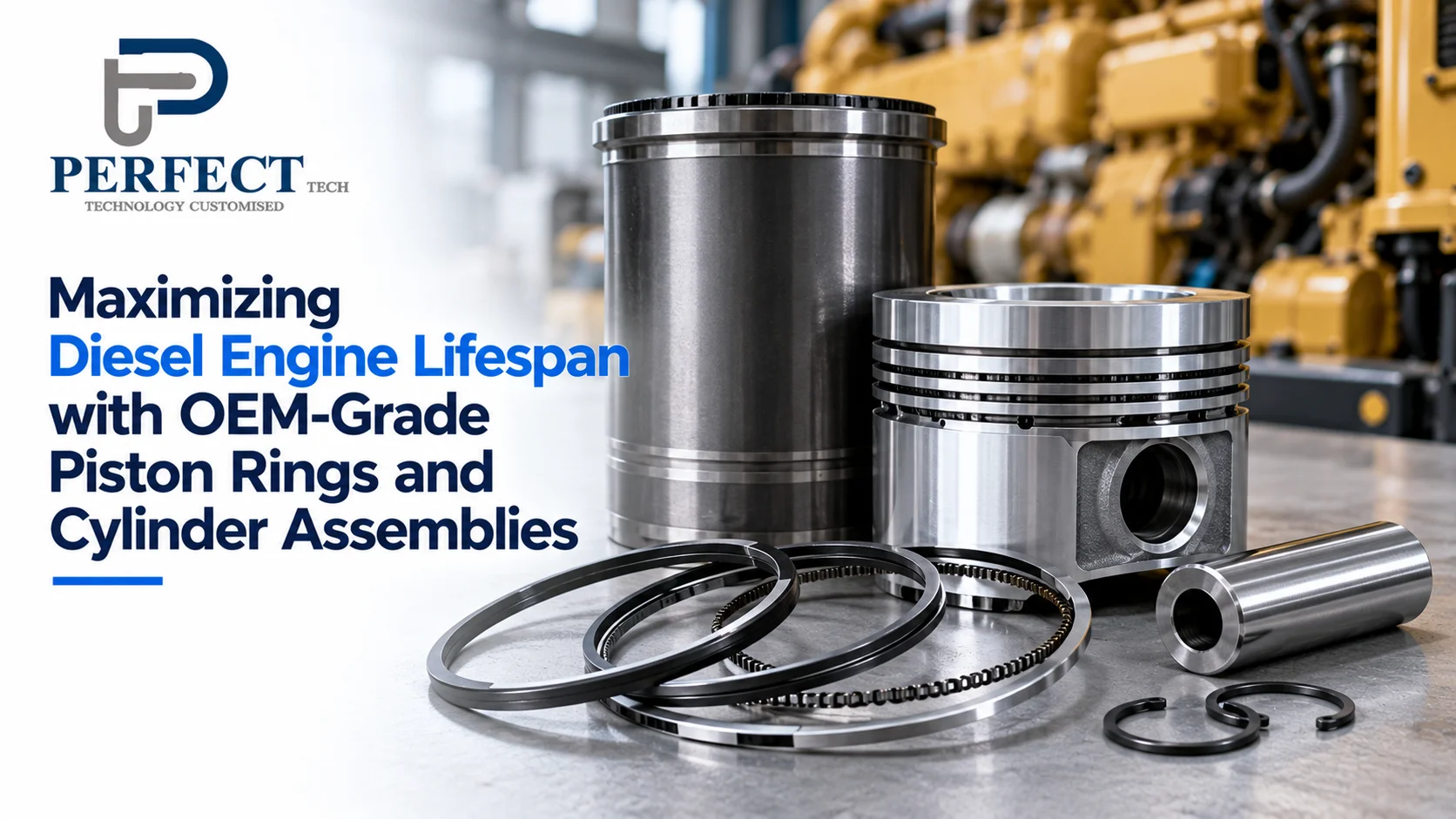
Diesel engines used in generators, heavy machinery, industrial equipment, and Ground Support Equipment (GSE) are designed to operate under demanding conditions. High operating hours, heavy loads, temperature variations, dust, and frequent duty cycles can gradually increase wear inside the engine.
Among the most important components in this environment are the piston rings and cylinder assembly. These components directly influence compression, lubrication, combustion efficiency, and oil consumption. Using OEM diesel engine piston rings and correctly matched cylinder components can help maintenance teams restore engine performance and support reliable long-term operation.
For fleet managers, diesel engine technicians, procurement teams, and industrial equipment operators, understanding piston-ring and cylinder wear is essential for making informed maintenance decisions.
What Do Diesel Engine Piston Rings Do?
Piston rings are fitted into grooves around the piston and perform several critical functions inside the cylinder.
Their primary roles include:
- Maintaining combustion-gas sealing
- Controlling engine oil on the cylinder wall
- Transferring heat from the piston toward the cylinder
- Supporting efficient combustion
- Helping maintain compression
A typical piston assembly can include different ring types, such as:
Compression Rings
Compression rings help seal combustion gases between the piston and cylinder wall.
Poor compression-ring sealing can contribute to:
- Reduced compression
- Blow-by
- Loss of engine power
- Increased crankcase pressure
- Difficult starting
Oil Control Rings
Oil control rings regulate the amount of lubricating oil remaining on the cylinder wall.
If oil control becomes ineffective, the engine may experience increased oil consumption and exhaust smoke.
Why OEM Diesel Engine Piston Rings Matter
Piston rings may look like relatively simple components, but their dimensions and operating characteristics are highly specific to the engine.
OEM diesel engine piston rings are designed for a particular engine configuration and cylinder environment.
Important characteristics can include:
- Ring diameter
- Ring thickness
- Ring profile
- Ring material
- Surface treatment
- Ring tension
- Groove compatibility
- Cylinder-wall compatibility
Using an incorrectly specified ring can lead to poor sealing, accelerated wear, oil-consumption problems, or installation difficulties.
For industrial engines, accurate component identification is therefore essential.
How Piston Rings Affect Diesel Engine Performance
Piston rings have a direct relationship with several aspects of engine performance.
Compression
Effective ring sealing helps retain combustion pressure above the piston.
Worn or damaged rings can allow combustion gases to pass into the crankcase, a condition commonly associated with blow-by.
Oil Consumption
Oil-control rings help prevent excessive lubricant from entering the combustion chamber.
When ring or cylinder wear increases, oil consumption may rise.
Combustion Efficiency
Maintaining appropriate compression supports proper combustion conditions.
Ring problems can therefore contribute to reduced engine performance and increased operating costs.
Engine Temperature
Piston rings also contribute to transferring heat from the piston toward the cylinder wall.
Poor ring contact or incorrect installation can interfere with normal thermal behavior.
Signs of Worn Piston Rings
Maintenance teams should investigate piston-ring wear when an engine shows symptoms such as:
- Increased oil consumption
- Excessive exhaust smoke
- Reduced compression
- Loss of engine power
- Increased crankcase pressure
- Excessive blow-by
- Difficult starting
- Poor fuel efficiency
- Abnormal piston or cylinder wear
These symptoms can have multiple causes, so proper diagnosis should be performed before replacing piston rings.
Understanding Cylinder Assembly Components
Piston rings do not operate independently. Their performance depends heavily on the condition of the cylinder assembly.
Depending on the engine design, a cylinder assembly may involve:
- Cylinder liner
- Piston
- Piston rings
- Piston pin
- Connecting components
- Sealing elements
The relationship between these components determines how effectively the engine maintains compression and controls lubrication.
Cylinder Liners
The cylinder liner provides the working surface against which the piston rings operate.
A worn or damaged liner can prevent new piston rings from sealing correctly.
Potential liner problems include:
- Excessive wear
- Scoring
- Pitting
- Distortion
- Incorrect surface finish
- Excessive taper
- Out-of-round condition
Installing new rings into a severely worn cylinder may not provide the expected improvement.
Why Piston Rings and Cylinder Liners Should Be Evaluated Together
One of the most common mistakes during engine overhaul is focusing only on the piston rings.
A new ring set cannot compensate for a cylinder that is outside acceptable wear limits.
Before installing OEM diesel engine piston rings, technicians should evaluate the cylinder condition according to the engine manufacturer’s specifications.
Important measurements can include:
- Cylinder diameter
- Taper
- Out-of-round condition
- Liner protrusion, where applicable
- Surface condition
- Ring end gap
- Piston-to-cylinder clearance
The exact limits depend on the engine manufacturer and model.
1. Check Compression Before Disassembly
Compression testing can provide useful information about engine condition.
Low compression may be associated with:
- Worn piston rings
- Cylinder wear
- Valve problems
- Head-gasket issues
- Other internal engine faults
Compression results should be interpreted alongside other diagnostic information rather than used as the sole basis for replacing piston rings.
2. Monitor Engine Oil Consumption
Increasing oil consumption can be an early warning sign of internal wear.
However, technicians should also investigate:
- External oil leaks
- Turbocharger condition
- Valve-guide or seal condition
- Crankcase ventilation
- Incorrect oil specification
- Operating conditions
Oil consumption alone does not prove piston-ring failure.
3. Inspect Crankcase Blow-By
Excessive blow-by can indicate that combustion gases are passing past the piston rings.
The engine manufacturer’s specified testing procedure should be followed when measuring crankcase pressure or blow-by.
A significant change from established baseline readings can justify further internal inspection.
4. Inspect the Cylinder Surface
During overhaul, inspect the cylinder or liner for:
- Scoring
- Scratches
- Excessive glazing
- Wear
- Corrosion
- Pitting
- Uneven surface patterns
The cylinder surface must provide the appropriate environment for piston-ring seating and lubrication.
5. Measure Ring End Gap
Piston-ring end gap is an important installation measurement.
If the gap is too small, thermal expansion can cause the ring ends to contact each other, potentially increasing cylinder-wall damage.
If the gap is excessive, combustion sealing may be compromised.
Always use the engine manufacturer’s specified measurement and installation procedure.
6. Verify Ring Groove Condition
The piston ring must move correctly within its piston groove.
Inspect grooves for:
- Carbon buildup
- Wear
- Damage
- Excessive clearance
- Deformation
A worn piston groove can affect ring movement and sealing even when a new ring is installed.
7. Use the Correct Lubrication
Correct engine lubrication is essential for piston-ring and cylinder life.
Maintenance teams should use the lubricant grade and specification recommended for the particular engine.
Incorrect lubrication can contribute to:
- Excessive wear
- Deposits
- Poor ring seating
- Increased oil consumption
- Reduced component life
Oil-change intervals should also follow the manufacturer’s recommendations and actual operating conditions.
8. Follow Correct Break-In Procedures
After an engine overhaul or piston-ring replacement, proper break-in procedures can be important for achieving appropriate ring seating.
Depending on the engine manufacturer, break-in may involve controlled operating temperatures, loads, and engine speeds.
Technicians should follow the engine manufacturer’s overhaul and commissioning instructions rather than applying a generic break-in procedure.
Common Causes of Premature Piston-Ring Wear
Several factors can shorten piston-ring service life.
Poor Air Filtration
Dust entering the combustion chamber can act as an abrasive and accelerate wear of:
- Piston rings
- Cylinder liners
- Pistons
This is particularly important for engines operating in dusty industrial or construction environments.
Incorrect Lubrication
Using unsuitable oil or extending service intervals beyond recommended limits can increase internal wear.
Engine Overheating
Excessive operating temperatures can increase thermal stress and may affect piston, ring, and cylinder performance.
Excessive Engine Loading
Continuous operation beyond the intended duty cycle can increase thermal and mechanical stress.
Improper Installation
Incorrect ring orientation, damaged rings, incorrect clearances, or improper assembly techniques can cause premature failure.
Poor-Quality Replacement Parts
Components that do not meet the engine’s required dimensional and material specifications may provide inconsistent performance.
OEM vs. Generic Piston Rings
When replacing piston rings, procurement teams often have to decide between OEM components and alternative aftermarket products.
The important consideration is not simply the label on the packaging. The replacement component must meet the technical requirements of the specific engine.
Evaluate:
- Dimensional accuracy
- Material
- Ring profile
- Surface treatment
- Tension characteristics
- Manufacturing quality
- Compatibility
- Technical documentation
- Supplier traceability
For critical industrial equipment, procurement teams should verify the component’s specifications and suitability before installation.
Selecting OEM Diesel Engine Piston Rings
When sourcing OEM diesel engine piston rings, collect the following information:
- Engine manufacturer
- Engine model
- Engine serial number
- Engine arrangement or configuration number, where applicable
- Existing piston-ring part number
- Piston part number
- Cylinder liner part number
- Bore diameter
- Application
- Clear photographs of the existing components
This information can help prevent incorrect part selection.
Why the Engine Serial Number Matters
The same engine model can sometimes have different configurations or production variations.
The serial number can help identify the specific engine configuration and applicable components.
For procurement teams, providing complete engine identification information is much safer than ordering a ring set based only on a general engine family name.
Piston Ring Maintenance Best Practices
To maximize component life, maintenance teams should focus on the complete engine system.
Maintain Air Filtration
Replace or service air filters according to manufacturer requirements and operating conditions.
Monitor Lubricating Oil
Check oil level and condition regularly and use the specified lubricant.
Monitor Engine Temperature
Investigate abnormal temperature increases promptly.
Track Oil Consumption
Record oil consumption trends rather than relying only on individual readings.
Monitor Engine Performance
Changes in:
- Power
- Smoke
- Starting
- Blow-by
- Fuel consumption
can provide useful indications of developing problems.
Maintain Accurate Service Records
Record:
- Engine hours
- Oil changes
- Filter replacements
- Overhauls
- Piston-ring replacements
- Cylinder-liner replacements
- Part numbers
This information can support future maintenance planning.
Piston Rings in Industrial Generator Engines
Diesel generators often operate for extended periods and may experience frequent load changes.
Piston-ring condition can therefore have a significant impact on:
- Engine compression
- Oil consumption
- Fuel efficiency
- Load performance
- Exhaust emissions
- Overall engine reliability
For standby generators, maintenance teams should consider both operating hours and calendar age. For prime-power applications, engine hours and duty cycle become especially important.
Piston Rings in Heavy Equipment
Heavy machinery can operate in demanding environments where dust, high loads, and extended operating periods increase component wear.
Examples include:
- Construction equipment
- Mining machinery
- Material-handling equipment
- Agricultural machinery
- Industrial engines
For these applications, air filtration, lubrication, cooling, and load management are particularly important for piston and cylinder longevity.
Piston Rings and Aviation GSE
Diesel engines are also used in certain Ground Support Equipment applications.
Examples can include:
- Tow tractors
- Baggage equipment
- Ground power equipment
- Service vehicles
- Specialized airport machinery
GSE engines can experience frequent starts, stops, and variable loads.
Maintaining piston and cylinder components can therefore be part of a broader GSE preventive-maintenance strategy.
When Should Piston Rings Be Replaced?
There is no single replacement interval that applies to every diesel engine.
Replacement decisions should be based on:
- Engine manufacturer recommendations
- Operating hours
- Compression measurements
- Blow-by
- Oil consumption
- Cylinder measurements
- Visual inspection
- Engine performance
- Maintenance history
During an overhaul, technicians should determine whether the cylinder liners, pistons, rings, and related components remain within the manufacturer’s acceptable limits.
Why Accurate Spare-Part Matching Matters
Industrial diesel engines can have multiple component variations.
Ordering a piston ring set based only on bore diameter can be risky because different engine configurations may use different:
- Ring profiles
- Ring thicknesses
- Materials
- Groove dimensions
- Coatings
- Part numbers
The safest procurement process starts with complete engine identification.
How Perfect Tech Can Help
Perfect Tech supports industrial spare-parts sourcing and technical component matching for diesel engines, generators, heavy machinery, and aviation GSE applications.
If you need OEM diesel engine piston rings or related cylinder components, provide our team with:
- Engine manufacturer
- Engine model
- Engine serial number
- Existing part number
- Cylinder or liner information
- Piston information
- Nameplate photographs
- Technical documentation
Our team can assist with identifying and sourcing the appropriate components based on your equipment configuration.
Related components may include:
- Piston ring sets
- Cylinder liners
- Pistons
- Gaskets
- Sealing components
- Engine overhaul parts
- Other diesel engine spare parts
Frequently Asked Questions
What do diesel engine piston rings do?
Piston rings help seal combustion gases, control lubricating oil, and transfer heat from the piston toward the cylinder wall.
Why are OEM diesel engine piston rings important?
OEM-specification rings are designed to meet the dimensional and operating requirements of the intended engine configuration. Correct compatibility is essential for proper sealing and service life.
Can new piston rings be installed in an old cylinder liner?
It depends on the condition and measured dimensions of the cylinder liner. If the liner exceeds the manufacturer’s wear limits, additional machining or replacement may be required.
What causes piston rings to wear quickly?
Common contributors include dust ingestion, inadequate lubrication, overheating, excessive loading, poor installation, incorrect clearances, and unsuitable replacement components.
How can I identify the correct piston ring set?
Provide the engine manufacturer, model, serial number, existing part number, and relevant piston or cylinder information. A clear engine nameplate photograph can also help with identification.
Do piston rings improve engine performance?
Replacing worn rings with correctly specified components can restore compression and oil control when ring and cylinder wear are contributing to the engine’s performance problems. The actual result depends on the overall engine condition.
Conclusion
Piston rings and cylinder assemblies play a fundamental role in diesel engine performance. Proper ring sealing supports compression, oil control, combustion efficiency, and reliable engine operation.
Using correctly specified OEM diesel engine piston rings, maintaining appropriate lubrication and filtration, monitoring engine condition, and evaluating piston and cylinder components together can help extend engine service life and reduce avoidable failures.
For industrial generators, heavy machinery, and aviation GSE, proactive maintenance and accurate spare-part identification are especially important because unexpected engine downtime can affect wider operations.
If you need OEM diesel engine piston rings, cylinder liners, pistons, or related engine components, contact Perfect Tech. Share your engine model, serial number, existing part number, or nameplate details, and our team can assist with technical part matching and industrial spare-parts sourcing.
